how doctors offices choose what to ask on forms race
Dearest Reader,
If demographic benchmarks and trends are essential to your business and the research yous conduct (things like historic period, gender, race, ethnicity, and region) and then this newsletter has information y'all absolutely demand to know.
Why? Because the U.S. Demography Agency continues to change how it collects and classifies demographic data. Right now the Bureau is engaged in its every-x-years Big census that will survey every household in the nation. Information technology will have a lasting impact on all of us for at least the next ten years.
Our feature commodity on How to Inquire Race & Ethnicity on a Survey highlights what the Census Bureau is doing, and how it will affect your business organization and the research you lot conduct.
Other items of interest in this newsletter include:
- Why Your CEO Loves NPS: It Is Never Audited, and It Never Declines
- Why You Should Be Using Conjoint Assay
- Avoid Numeric Response Scales in Surveys (Here's Why)
- Forget the Math: A Conceptual Guide for Adept Sampling
- AI (Bogus Intelligence) Simply Rescued Our Survey!
- New Data on COVID-19 Highlights Crucial Role of Inquiry
- How to Trap Survey Trolls: Ask Them for a Story
- Five Best Practices for Keeping Your Data "Anonymous"
- If Truth Matters, Prove It with a Survey
- A Video Report Example with Blitheness and Insight
We are as well delighted to share with you:
- Versta Research in the News
… which showcases some of our recent work for the Alzheimer's Association, a customer satisfaction survey highlighted in the latest effect of Quirk's, and a masterclass for business organization students at the Academy of Illinois in Chicago.
As e'er, experience free to reach out with an research or with questions you may have. We would be pleased to consult with you lot on your next research endeavour.
Happy spring,
The Versta Squad
How to Ask Race & Ethnicity on a Survey
The most thoroughly tested and validated survey questions ever on the planet are probably the 2020 Demography questions on race and ethnicity. Census Bureau researchers have spent tens of millions of dollars over the by decade interviewing hundreds of thousands of Americans about race.
As a effect, the Census Bureau has implemented a few changes for the 2020 decennial demography, i piece of which involves documenting the race and ethnicity of every person in the Us. Does information technology mean you should be replicating the Census questions in your ain surveys?
Possibly yes, probably no.
To help you sort through the problems, this commodity describes contempo changes to the 2020 Demography and helps you lot assess how the new race and ethnicity questions volition probable bear upon your ain research and survey piece of work in the futurity.
Right at present the 2020 Census questions on race and ethnicity may well exist the most thoroughly tested and validated survey questions ever on the planet.
Here is what we cover:
- Race and ethnicity are asked differently from years past. Nosotros'll show you the old and the new, and explain why Demography Bureau researchers had hoped for even bigger changes.
- The new questions are circuitous, just like the old ones, which some people find confusing. But survey respondents are resilient. We'll provide a brief overview of how the questions were validated.
- Y'all volition have to incorporate the new questions into your work. There is no choice if you lot want to reference census data. Just should it change your approach to asking about race and ethnicity in your own surveys? We'll testify you lot our recommended approach.
No, the Census Race & Ethnicity Questions Are Not That Disruptive
We'll start with the second item noted above, because it was a complaint by an manufacture colleague that prompted u.s. to brainstorm looking at the upshot more closely for this newsletter.
Hither is what this colleague posted on a market research discussion forum:
The race question is very odd. I don't recollect any of united states of america in the research community (quant or qual) would have asked the question this mode. The question groupings and listed categories are very odd. And the required open up-terminate is bound to go a bunch of garbage. How on earth will they analyze the open-ends and find meaningful, quantifiable data?
Researchers certainly can act like know-it-alls when it comes to designing surveys (even the ones who don't really design surveys). I can empathize, because I, too, am prone to critiquing other people's surveys. Moreover, I agree that the new race and ethnicity questions are non platonic.
But wait. It turns out the researchers at the U.S. Demography Agency agree as well, so allow'south requite them the credit they deserve. They know tons more than about how to ask these questions than any online critics in the market enquiry industry. In fact, they spent over x years and millions of dollars testing their questions. Correct now the 2020 Census questions on race and ethnicity may well be the most thoroughly tested and validated survey questions always on the planet.
The Census Agency conducted the largest quantitative effort ever on how people place their race and ethnicity.
Style dorsum in 2010 the Bureau conducted an experiment to begin preparing for the 2020 Demography. Their experiment was "the largest quantitative effort always on how people place their race and ethnicity." It involved experimental questionnaires mailed to a sample of 488,604 households during the 2010 Census. And then they chosen over 60,000 of those households to re-interview them by telephone. In addition, they conducted 67 focus groups across the United States and in Puerto Rico with about 800 people. A detailed study of their methods and findings are available in a 151-page report.
Even before that effort, the Agency conducted one-on-one cognitive interviewing to test for misunderstandings or misinterpretations of the wording. Here is what that involved:
The protocol for the cognitive interviews combined verbal call up-aloud reports with retrospective probes and debriefing. Each cognitive interview involved two interviewers working together, face-to-face with the respondent. Ane interviewer read the RI questionnaire every bit if he or she was conducting the actual phone interview. Meanwhile, another interviewer observed the interview, took notes, and later asked cognitive interview and retrospective debriefing questions after the RI questionnaire was complete. The cognitive interview and probing questions aimed to explore respondents' agreement of the race and Hispanic origin questions, their typical response to these questions, any variation that they might have in reporting race and origin, and their sense of brunt of the interview. The debriefing probes were semi-scripted, allowing the interviewer to probe on things that occurred spontaneously while as well covering a ready of required material.
Then in 2015 the Bureau launched another round of enquiry. They tested question format (ane question vs. two), response categories (including Heart Eastern or Due north African, for example), instruction wording (using phrases similar, "select all that use," for case), and question terminology (such as race, origin, ethnicity, etc.) to examination alternative versions of the question, and to empathize any potential problems with mode effects (postal service questionnaire vs. online vs. in-person). They sampled and mailed to over 1 million households, and selected about 100,000 of those households for follow-upwards phone interviews. You tin read well-nigh their methods and findings for this phase of research in a 380-folio report.
If only we could all test our survey questions this thoroughly and and then painstakingly!
It is true that the current ethnicity and race questions are not platonic (come across the side by side section for why). But it is admittedly not true that the results will be "garbage." At this point, Census Bureau researchers know a great bargain almost how people answer to the questions laid out on the census forms. And they know how to code and tabulate the responses to get a valid and reliable profile of our population.
The New vs. the Onetime
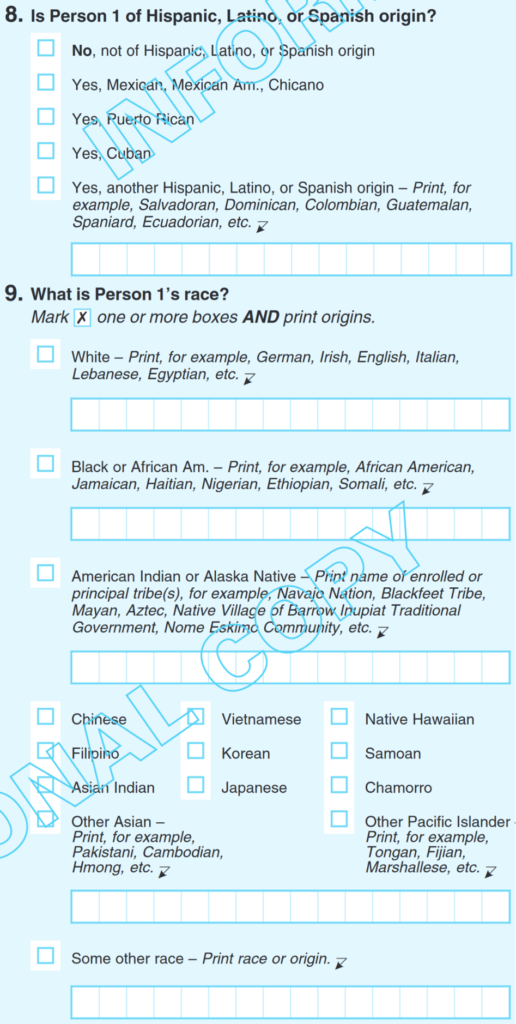
Wondering what all the fuss is about? Hither are the new 2020 Census questions on ethnicity and race:
Compare this with 2010:
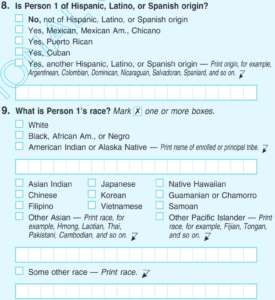
There is ane reason neither version is platonic, and it has nothing to practise with open-end boxes. It's because Hispanic or Latino is asked separately from race, so when Hispanic/Latino respondents get to the question about race, many of them will select "other."
Census researchers know this. They strongly recommended that Hispanic/Latino be integrated into the race question for the 2020 Census. But they ran upward confronting a 1997 law requiring federal agencies to specify five minimum categories for data on race (American Indian or Alaska Native; Asian; Black or African American; Native Hawaiian or Other Pacific Islander; White) and ii categories for data on ethnicity (Hispanic or Latino; Not Hispanic or Latino). The recommended changes to this law were ignored past the White Business firm, and unfortunately Congress did not step in to gear up it.
There are, however, some other interesting changes that did not require changes to the constabulary. First, the discussion Negro has been dropped. Second, most respondents are at present asked to specify their origins along with their race. The thought is to capture a more than nuanced portrait of which countries, tribes, and regions of the world Americans of all races come from.
How to Ask Race on YOUR Survey
For several years nosotros wrote surveys that replicated the Census' two-question format asking for race and ethnicity, and we recommended that clients do the same. The reason is that usually you (nosotros) must weight your data to Census benchmarks to ensure representative samples. Or, nosotros need to compare your data to those benchmarks to gain a deeper understanding of your markets.
But clients are just like other Americans! Few of them think of "Hispanic or Latino" as beingness a category split from race. So in our analysis and reporting we found ourselves nearly e'er recoding the data into a single race variable, and then applying that aforementioned recoding to Census numbers to make our comparisons.
Over the last few years, then, we landed on this version of a race/ethnicity question for our surveys:
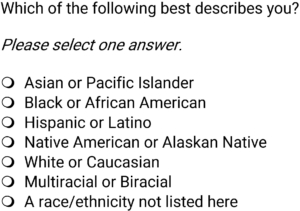
Note that the response options are in alphabetical order, except for the last ii lines. Nosotros accept found that this question works extremely well. Few people utilize the "other" category. It doesn't offend or confuse people. And then with merely a little bit of elementary analysis and coding piece of work, it hands maps onto electric current and futurity Census data:
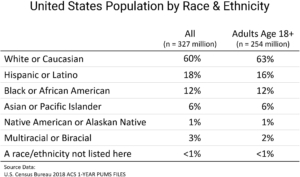
This is how nosotros at present recommend nearly clients ask most race in their surveys, with some exceptions. If you need to track confronting your historical data, information technology may not work. If your customers are unique, varied immigrant populations (like one of our Chicago clients) you may want different details.
Whatever you practice, remember advisedly most your approach — as carefully and thoughtfully as our colleagues in the Census Bureau have done. Although yous cannot test every bit exhaustively as they have washed, you don't demand to. The Census Bureau has provided an astonishing foundation of knowledge and data you lot tin can feel confident relying on for your ain work.
Stories from the Versta Blog
Here are several contempo posts from the Versta Research Blog. Click on any headline to read more.
Versta Research in the News
Source: https://verstaresearch.com/newsletters/how-to-ask-race-ethnicity-on-a-survey/
0 Response to "how doctors offices choose what to ask on forms race"
Postar um comentário