after ww1 what was the most difficult thing for the us to accept quizlet
| Role of the interwar period | |
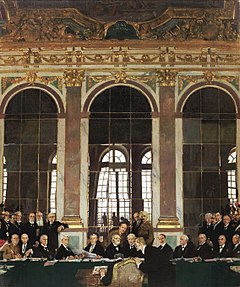 William Orpen'south The Signing of Peace in the Hall of Mirrors: the signing of the Treaty of Versailles in the Hall of Mirrors at the Palace of Versailles in 1919 | |
| Date | Nov 1918 – |
|---|---|
| Outcome | Political and social changes such as :
|
The aftermath of World State of war I saw desperate political, cultural, economic, and social change beyond Eurasia, Africa, and even in areas outside those that were directly involved. 4 empires collapsed due to the war, old countries were abolished, new ones were formed, boundaries were redrawn, international organizations were established, and many new and old ideologies took a firm hold in people's minds. World War I besides had the effect of bringing political transformation to most of the principal parties involved in the disharmonize, transforming them into electoral democracies by bringing nigh-universal suffrage for the first time in history, as in Germany (1919 German language federal ballot), Bully United kingdom (1918 United Kingdom general election), and Turkey (1923 Turkish general ballot).[ citation needed ]
Blockade of Germany [edit]
Through the menstruum from the armistice on 11 November 1918 until the signing of the peace treaty with Germany on 28 June 1919, the Allies maintained the naval blockade of Deutschland that had begun during the war. Equally Deutschland was dependent on imports, it is estimated that 523,000 civilians had lost their lives.[i] Due north. P. Howard, of the University of Sheffield, says that a further quarter of a million more died from affliction or starvation in the eight-month period following the conclusion of the disharmonize.[ii] The continuation of the blockade later the fighting ended, equally author Robert Leckie wrote in Delivered From Evil, did much to "torment the Germans ... driving them with the fury of despair into the arms of the devil."[ citation needed ] The terms of the Armistice did allow food to exist shipped into Federal republic of germany, only the Allies required that Germany provide the means (the aircraft) to exercise then. The High german government was required to employ its gold reserves, being unable to secure a loan from the Usa.[ commendation needed ]
Historian Sally Marks claims that while "Allied warships remained in identify against a possible resumption of hostilities, the Allies offered food and medicine afterwards the armistice, but Germany refused to allow its ships to carry supplies". Further, Marks states that despite the problems facing the Allies, from the German regime, "Allied food shipments arrived in Allied ships before the accuse fabricated at Versailles".[3] This position is likewise supported by Elisabeth Gläser who notes that an Allied task force, to help feed the German population, was established in early on 1919 and that by May 1919 " Germany [had] became the chief recipient of American and Allied food shipments". Gläser further claims that during the early months of 1919, while the chief relief effort was existence planned, France provided food shipments to Bavaria and the Rhineland. She farther claims that the High german government delayed the relief effort by refusing to surrender their merchant armada to the Allies. Finally, she concludes that "the very success of the relief endeavour had in effect deprived the [Allies] of a credible threat to induce Germany to sign the Treaty of Versailles.[four] However, it is also the case that for eight months following the end of hostilities, the occludent was continually in place, with some estimates that a further 100,000 casualties among High german civilians due to starvation were caused, on summit of the hundreds of thousands which already had occurred. Nutrient shipments, furthermore, had been entirely dependent on Allied goodwill, causing at least in part the post-hostilities irregularity.[5] [half dozen]
Paris Peace Conference [edit]
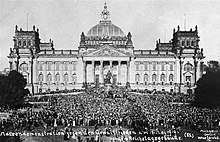
Later on the Paris Peace Conference of 1919, the signing of the Treaty of Versailles on 28 June 1919, between Germany on the i side and France, Italy, Great britain and other minor allied powers on the other, officially ended war between those countries. Other treaties ended the relationships of the United States and the other Primal Powers. Included in the 440 manufactures of the Treaty of Versailles were the demands that Germany officially accept responsibility "for causing all the loss and damage" of the war and pay economical reparations. The treaty drastically limited the German military machine: High german troops were reduced to 100,000 and the country was prevented from possessing major military armaments such as tanks, warships, armored vehicles and submarines.
Influenza epidemic [edit]
Historians go along to fence about the impact the 1918 flu pandemic had on the outcome of the war. It has been posited that the Fundamental Powers may have been exposed to the viral wave before the Allies. The resulting casualties having greater effect, having been incurred during the state of war, as opposed to the allies who suffered the brunt of the pandemic after the Ceasefire. When the extent of the epidemic was realized, the respective censorship programs of the Allies and Central Powers limited the public's knowledge regarding the true extent of the affliction. Because Spain was neutral, their media was free to report on the Influenza, giving the impression that it began there. This misunderstanding led to gimmicky reports naming it the "Spanish influenza." Investigative work by a British squad led by virologist John Oxford of St Bartholomew'due south Infirmary and the Royal London Hospital, identified a major troop staging and hospital campsite in Étaples, France as almost certainly being the center of the 1918 flu pandemic. A pregnant precursor virus was harbored in birds, and mutated to pigs that were kept near the front.[8] The verbal number of deaths is unknown but almost l 1000000 people are estimated to have died from the influenza outbreak worldwide.[ix] [10] In 2005, a study found that, "The 1918 virus strain developed in birds and was like to the 'bird flu' that in the 21st century spurred fears of some other worldwide pandemic, nonetheless proved to be a normal treatable virus that did not produce a heavy impact on the world's health."[eleven]
Ethnic minorities [edit]
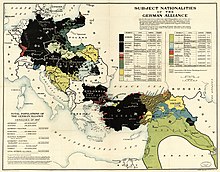
Field of study nationalities of the German language alliance
The dissolution of the German, Russian, Austro-Hungarian and Ottoman empires created a number of new countries in eastern Europe and the Middle Eastward.[12] Some of them, such every bit Czechoslovakia and Poland, had substantial ethnic minorities who were sometimes not fully satisfied with the new boundaries that cut them off from boyfriend ethnics. For example, Czechoslovakia had Germans, Poles, Ruthenians and Ukrainians, Slovaks and Hungarians. The League of Nations sponsored various Minority Treaties in an attempt to deal with the problem, but with the reject of the League in the 1930s, these treaties became increasingly unenforceable. One consequence of the massive redrawing of borders and the political changes in the backwash of the war was the large number of European refugees. These and the refugees of the Russian Civil State of war led to the creation of the Nansen passport.
Ethnic minorities made the location of the frontiers generally unstable. Where the frontiers have remained unchanged since 1918, there has often been the expulsion of an indigenous group, such as the Sudeten Germans. Economic and military cooperation amid these small states was minimal, ensuring that the defeated powers of Germany and the Soviet Union retained a latent capacity to boss the region. In the immediate backwash of the state of war, defeat drove cooperation betwixt Deutschland and the Soviet Union but ultimately these two powers would compete to dominate eastern Europe.
Approximately 1.5 million Armenians, native inhabitants of the Armenian Highland, were exterminated in Turkey as a issue of the Genocide of Armenians committed by the Young Turk Regime.
Political upheavals [edit]
New nations break complimentary [edit]
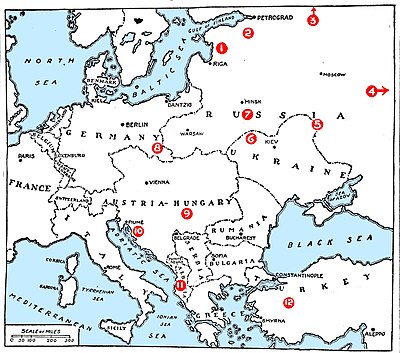
German and Austrian forces in 1918 defeated the Russian armies, and the new communist government in Moscow signed the Treaty of Brest-Litovsk in March 1918. In that treaty, Russia renounced all claims to Estonia, Finland, Latvia, Lithuania, Ukraine, and the territory of Congress Poland, and information technology was left to Germany and Austro-hungarian empire "to determine the time to come status of these territories in agreement with their population." Afterward, Vladimir Lenin's regime likewise renounced the Partition of Poland treaty, making it possible for Poland to claim its 1772 borders. However, the Treaty of Brest-Litovsk was rendered obsolete when Germany was defeated later in 1918, leaving the status of much of eastern Europe in an uncertain position.
Revolutions [edit]
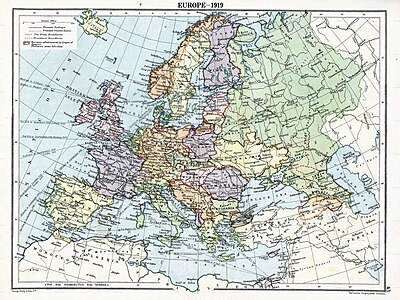
A far-left and ofttimes explicitly Communist revolutionary wave occurred in several European countries in 1917–1920, notably in Germany and Republic of hungary. The unmarried nearly important event precipitated past the privations of World War I was the Russian Revolution of 1917.
Deutschland [edit]
In Germany, in that location was a socialist revolution which led to the brief establishment of a number of communist political systems in (mainly urban) parts of the country, the abdication of Kaiser Wilhelm Ii, and the creation of the Weimar Republic.
On 28 June 1919 the Weimar Republic was forced, under threat of continued Allied accelerate, to sign the Treaty of Versailles. Germany viewed the one-sided treaty as a humiliation and as blaming information technology for the entire state of war. While the intent of the treaty was to assign guilt to Germany to justify fiscal reparations, the notion of blame took root equally a political event in German language society and was never accepted by nationalists, although it was argued by some, such as German historian Fritz Fischer. The High german government disseminated propaganda to further promote this idea, and funded the Centre for the Study of the Causes of the War to this finish.
132 billion gold marks ($31.5 billion, half dozen.6 billion pounds) were demanded from Deutschland in reparations, of which only 50 billion had to be paid. In order to finance the purchases of foreign currency required to pay off the reparations, the new German republic printed tremendous amounts of money – to disastrous effect. Hyperinflation plagued Germany between 1921 and 1923. In this period the worth of fiat Papiermarks with respect to the earlier commodity Goldmarks was reduced to one trillionth (ane million millionth) of its value.[13] In Dec 1922 the Reparations Commission alleged Germany in default, and on xi January 1923 French and Belgian troops occupied the Ruhr until 1925.
The treaty required Germany to permanently reduce the size of its army to 100,000 men, and destroy their tanks, air strength, and U-gunkhole fleet (her capital ships, moored at Scapa Flow, were scuttled by their crews to foreclose them from falling into Allied hands).
Germany saw relatively small amounts of territory transferred to Denmark, Czechoslovakia, and Belgium, a larger amount to France (including the temporary French occupation of the Rhineland) and the greatest portion as role of a reestablished Poland. Germany's overseas colonies were divided between a number of Allied countries, most notably the U.k. in Africa, just it was the loss of the territory that composed the newly independent Polish country, including the German language metropolis of Danzig and the separation of Due east Prussia from the rest of Germany, that caused the greatest outrage[ citation needed ]. Nazi propaganda would feed on a general German language view that the treaty was unfair – many Germans never accepted the treaty equally legitimate, and lent their political support to Adolf Hitler.[ commendation needed ]
Russian Empire [edit]
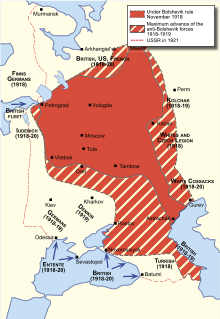
The Soviet Union benefited from Germany's loss, equally one of the beginning terms of the armistice was the abrogation of the Treaty of Brest-Litovsk. At the time of the armistice Russia was in the grips of a civil war which left more than than seven million people dead and large areas of the country devastated. The nation as a whole suffered socially and economically.
Lithuania, Latvia and Estonia gained independence. They were occupied once again by the Soviet Spousal relationship in 1940.
Republic of finland gained a lasting independence, though she repeatedly had to fight the Soviet Union for her borders.
Armenia, Georgia, and Azerbaijan were established equally independent states in the Caucasus region. However, later withdrawal of Russian army in 1917 and during 1920 Turkish invasion of Armenia, Turkey captured the Armenian territory effectually Artvin, Kars, and Igdir, and these territorial losses became permanent. Every bit event of invasions of Turkey and Russian Red Army all three Transcaucasian countries were proclaimed as Soviet Republics in 1920 and over time were absorbed into the Soviet Marriage.
Romania gained Bessarabia from Russia.
The Russian concession in Tianjin was occupied by the Chinese in 1920; in 1924 the Soviet Wedlock renounced its claims to the district.
Republic of austria-Hungary [edit]
With the war having turned decisively against the Central Powers, the people of Austria-hungary lost religion in their allied countries, and even before the ceasefire in Nov, radical nationalism had already led to several declarations of independence in s-cardinal Europe after November 1918. Every bit the primal government had ceased to operate in vast areas, these regions found themselves without a government and many new groups attempted to fill the void. During this same period, the population was facing food shortages and was, for the most part, demoralized by the losses incurred during the state of war. Various political parties, ranging from ardent nationalists, to social democrats, to communists attempted to prepare governments in the names of the unlike nationalities. In other areas, existing nation states such every bit Romania engaged regions that they considered to be theirs. These moves created de facto governments that complicated life for diplomats, idealists, and the Western allies.
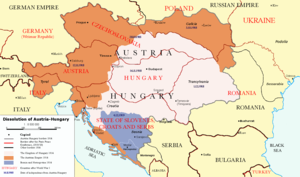
The Western forces were officially supposed to occupy the old Empire, but rarely had enough troops to do then finer. They had to deal with local authorities who had their ain agenda to fulfill. At the peace briefing in Paris the diplomats had to reconcile these government with the competing demands of the nationalists who had turned to them for assistance during the war, the strategic or political desires of the Western allies themselves, and other agendas such as a desire to implement the spirit of the Fourteen Points.
For example, in order to live upwardly to the ideal of self-conclusion laid out in the Fourteen Points, Germans, whether Austrian or High german, should exist able to decide their own time to come and government. Even so, the French specially were concerned that an expanded Germany would be a huge security chance. Further complicating the situation, delegations such as the Czechs and Slovenians fabricated strong claims on some German-speaking territories.
The effect was treaties that compromised many ideals, offended many allies, and set upwards an entirely new order in the expanse. Many people hoped that the new nation states would allow for a new era of prosperity and peace in the region, free from the biting quarrelling between nationalities that had marked the preceding l years. This hope proved far likewise optimistic. Changes in territorial configuration after World War I included:
- Establishment of the Republic of German Austria and the Hungarian Democratic Democracy, disavowing any continuity with the empire and exiling the Habsburg family in perpetuity.
- Eventually, after 1920, the new borders of Hungary did not include approx. 2-thirds of the lands of the onetime Kingdom of Hungary, including areas where the indigenous Magyars were in a majority. The new commonwealth of Republic of austria maintained control over most of the predominantly High german-controlled areas, simply lost diverse other German majority lands in what was the Austrian Empire.

With the Treaty of Trianon, Kingdom of Hungary lost 72% of its territory (including Croatia) and three.3 million people of Hungarian ethnicity.
- Bohemia, Moravia, Opava Silesia and the western function of the Duchy of Cieszyn, big function of Upper Republic of hungary and Carpathian Ruthenia formed the new Czechoslovakia.
- Galicia, the eastern part of the Duchy of Cieszyn, northern Árva County and northern Szepes County were transferred to Poland.
- the Southern one-half of the County of Tyrol and Trieste were granted to Italian republic.
- Bosnia and herzegovina, Republic of croatia-Slavonia, Međimurje, Dalmatia, Slovenia, Syrmia, parts of Bács-Bodrog, Baranya, Torontál and Temes Counties were joined with Serbia to form the Kingdom of the Serbs, Croats and Slovenes, later Yugoslavia.
- Transylvania, parts of Banat, Crișana, and Maramureș and Bukovina became part of Romania.
- The Austro-Hungarian concession in Tianjin was ceded to the Republic of China.
These changes were recognized in, but not caused by, the Treaty of Versailles. They were after further elaborated in the Treaty of Saint-Germain and the Treaty of Trianon.
The 1919 treaties generally included guarantees of minority rights, only there was no enforcement mechanism. The new states of eastern Europe more often than not all had big ethnic minorities. Millions of Germans found themselves in the newly created countries as minorities. More than two million ethnic Hungarians plant themselves living exterior of Hungary in Czechoslovakia, Romania and the Kingdom of the Serbs, Croats and Slovenes. Many of these national minorities constitute themselves in hostile situations because the modern governments were intent on defining the national graphic symbol of the countries, often at the expense of the other nationalities. The interwar years were hard for religious minorities in the new states congenital around ethnic nationalism. The Jews were particularly distrusted because of their minority faith and distinct subculture. This was a dramatic come-down from the days of the Austro-Hungarian Empire. Although antisemitism had been widespread during Habsburg rule, Jews faced no official discrimination considering they were, for the most part, ardent supporters of the multi-national state and the monarchy.[14]
The economic disruption of the state of war and the stop of the Austro-Hungarian customs union created peachy hardship in many areas. Although many states were prepare every bit democracies after the war, one past one, with the exception of Czechoslovakia, they reverted to some class of authoritarian dominion. Many quarreled among themselves but were also weak to compete effectively. Afterwards, when Germany rearmed, the nation states of south-primal Europe were unable to resist its attacks, and fell under German domination to a much greater extent than had always existed in Austria-hungary.
Ottoman Empire [edit]

At the end of the war, the Allies occupied Constantinople (İstanbul) and the Ottoman government collapsed. The Treaty of Sèvres, designed to repair damage caused by Ottomans during the state of war to the winning Allies, was signed by Ottoman Empire on 10 August 1920, but was never ratified by the Sultan.
The occupation of Smyrna by Hellenic republic on eighteen May 1919 triggered a nationalist motility to rescind the terms of the treaty. Turkish revolutionaries led by Mustafa Kemal Atatürk, a successful Ottoman commander, rejected the terms enforced at Sèvres and nether the guise of General Inspector of the Ottoman Army, left Istanbul for Samsun to organize the remaining Ottoman forces to resist the terms of the treaty. On the eastern front end, after the invasion of Armenia in 1920 and signing of the Treaty of Kars with the Russian S.F.S.R. Turkey took over territory lost to Armenia and post-Purple Russia.[15]
On the western front, the growing force of the Turkish nationalist forces led Greece, with the backing of Britain, to invade deep into Anatolia in an effort to bargain a accident to the revolutionaries. At the Battle of Dumlupınar, the Greek ground forces was defeated and forced into retreat, leading to the called-for of Smyrna and the withdrawal of Greece from Asia Minor. With the nationalists empowered, the regular army marched on to reclaim Istanbul, resulting in the Chanak Crunch in which the British Prime number Minister, David Lloyd George, was forced to resign. After Turkish resistance gained control over Anatolia and Istanbul, the Sèvres treaty was superseded past the Treaty of Lausanne (1923) which formally ended all hostilities and led to the creation of the modern Turkish Republic. As a result, Turkey became the only ability of Globe War I to overturn the terms of its defeat, and negotiate with the Allies as an equal.[16]
Lausanne Treaty formally acknowledged the new League of Nations mandates in the Centre East, the cession of their territories on the Arabian Peninsula, and British sovereignty over Cyprus. The League of Nations granted Class A mandates for the Mandate for Syria and the Lebanon and British Mandate of Mesopotamia and Palestine, the latter comprising two autonomous regions: Mandate Palestine and the Emirate of Transjordan. Parts of the Ottoman Empire on the Arabian Peninsula became part of what is today Saudi arabia and Republic of yemen. The dissolution of the Ottoman Empire became a pivotal milestone in the creation of the modern Heart East, the result of which bore witness to the creation of new conflicts and hostilities in the region.[17]
United kingdom [edit]
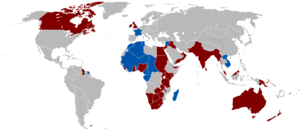
In the United Kingdom of Britain and Ireland, funding the state of war had a severe economical toll. From being the world'southward largest overseas investor, it became one of its biggest debtors with interest payments forming effectually twoscore% of all government spending. Inflation more doubled between 1914 and its summit in 1920, while the value of the Pound Sterling (consumer expenditure[18]) savage past 61.2%. War reparations in the form of free German coal depressed local industry, precipitating the 1926 General Strike.
British private investments abroad were sold, raising £550 1000000. Nonetheless, £250 million in new investment likewise took place during the war. The net financial loss was therefore approximately £300 million; less than two years investment compared to the pre-war average rate and more than replaced by 1928.[xix] Material loss was "slight": the most significant being xl% of the British merchant fleet sunk by High german U-boats. Most of this was replaced in 1918 and all immediately subsequently the state of war.[20] The military historian Correlli Barnett has argued that "in objective truth the Great War in no fashion inflicted crippling economic damage on Uk" just that the war "bedridden the British psychologically just in no other way".[21]
Less physical changes include the growing assertiveness of Commonwealth nations. Battles such equally Gallipoli for Australia and New Zealand, and Vimy Ridge for Canada led to increased national pride and a greater reluctance to remain subordinate to United kingdom, leading to the growth of diplomatic autonomy in the 1920s. These battles were often decorated in propaganda in these nations as symbolic of their power during the war. Colonies such as the British Raj (India) and Nigeria likewise became increasingly assertive because of their participation in the state of war. The populations in these countries became increasingly aware of their own ability and Britain's fragility.

Cartoon predicting the backwash of the war by Henry J. Glintenkamp, outset published in The Masses in 1914
In Ireland, the delay in finding a resolution to the Home Rule issue, exacerbated by the Government's severe response to the 1916 Easter Rising and its failed attempt to introduce conscription in Ireland in 1918, led to an increased back up for separatist radicals. This led indirectly to the outbreak of the Irish War of Independence in 1919. The cosmos of the Irish Free State that followed this conflict in effect represented a territorial loss for the Great britain that was all but equal to the loss sustained by Germany, (and furthermore, compared to Germany, a much greater loss in terms of its ratio to the country's prewar territory). Despite this, the Irish Costless State remained a rule inside the British Empire.
United States [edit]
While disillusioned by the war, information technology having not achieved the high ideals promised by President Woodrow Wilson, American commercial interests did finance Europe's rebuilding and reparation efforts in Germany, at least until the onset of the Great Depression. American opinion on the propriety of providing aid to Germans and Austrians was split, equally evidenced by an exchange of correspondence between Edgar Gott, an executive with The Boeing Company and Charles Osner, chairman of the Commission for the Relief of Destitute Women and Children in Germany and Republic of austria. Gott argued that relief should showtime go to citizens of countries that had suffered at the easily of the Primal Powers, while Osner made an appeal for a more than universal application of humanitarian ideals.[22] The American economic influence allowed the Great Depression to showtime a domino effect, pulling Europe in likewise.
France [edit]
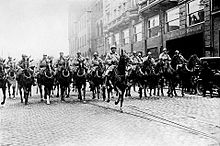
French cavalry entering Essen during the occupation of the Ruhr.
Alsace-Lorraine returned to France, the region which had been ceded to Prussia in 1871 after the Franco-Prussian War. At the 1919 Peace Conference, Prime Minister Georges Clemenceau's aim was to ensure that Frg would not seek revenge in the following years. To this purpose, the chief commander of the Allied forces, Marshal Ferdinand Foch, had demanded that for the future protection of France the Rhine river should now form the border betwixt France and Frg. Based on history, he was convinced that Deutschland would again become a threat, and, on hearing the terms of the Treaty of Versailles that had left Germany substantially intact, he observed that "This is non Peace. It is an Armistice for xx years."
The destruction brought upon French territory was to exist indemnified by the reparations negotiated at Versailles. This financial imperative dominated France'south strange policy throughout the 1920s, leading to the 1923 Occupation of the Ruhr in lodge to force Deutschland to pay. All the same, Germany was unable to pay, and obtained back up from the United States. Thus, the Dawes Plan was negotiated after Prime Minister Raymond Poincaré's occupation of the Ruhr, and then the Young Plan in 1929.
As well extremely important in the War was the participation of French colonial troops (who amounted for around ten% of the full number of troops deployed by France across the state of war), including the Senegalese tirailleurs, and troops from Indochina, Northward Africa, and Madagascar. When these soldiers returned to their homelands and connected to exist treated as second class citizens, many became the nuclei of pro-independence groups.
Furthermore, nether the land of war declared during the hostilities, the French economy had been somewhat centralized in lodge to exist able to shift into a "war economy", leading to a first breach with classical liberalism.
Finally, the socialists' back up of the National Union government (including Alexandre Millerand'south nomination every bit Minister of War) marked a shift towards the French Section of the Workers' International'southward (SFIO) turn towards social democracy and participation in "conservative governments", although Léon Blum maintained a socialist rhetoric.
Women in France [edit]
"But with its faceless country machinery and unremitting mechanized slaughter, the war instead collapsed these old ethics"[23] (Roberts 2). When the state of war was over and the men returned home, the world was a vastly different place than it had been before the war. Many ideals and behavior were shattered with the war. Those returning from the front lines, and even those who were on the Homefront, were left to pick up the pieces of what was left of those ideals and behavior, and try to rebuild them. Before the Great War, many thought this war would exist a quick war, like many before had been. With new engineering and weapons though, the war was at a stalemate for a big part of it, dragging what many thought would be a quick war out into a long, grueling war. With and then much expiry and destruction done to French republic, information technology is not surprising when looking back that the way of life for French citizens was forever changed.
Many citizens saw the change in culture and blamed the war for taking away the rose tinted glasses that society had viewed things through. Many scholars and writers, such as Drieu la Rochelle, found many means to describe this new view on reality such as stripping away apparel[24] (Roberts 2). This comparison of the new reality and wearable being stripped away also ties into the fact that gender roles changed greatly after the war.
During the state of war many jobs had been left to women considering many men were fighting on the front end lines. This gave women a new sense of freedom that they had not been able to feel ever earlier. Not many women wanted to become dorsum to how things were before the war, when they expected to stay at home and take care of the business firm. When the war was over many of the older generations and men wanted women to return to their previous roles.
At a time where gender roles were so heavily defined and intertwined with the culture of many places, for French citizens viewing how many women went against said roles after World State of war one, or the Great War as it was called at the time, it was ghastly. While gender roles had slowly been changing over fourth dimension since the Industrial Revolution gave more work options outside of the dwelling in factories, it had never been such a quick and desperate change equally it was after World War i. During the war many men went off to fight, leaving behind factory jobs that were normally seen as a homo's job just. These jobs had to be filled and without men in that location to fill the jobs, it was women who stepped up to fill up the hole instead. French republic suffered a peachy loss of life during Globe State of war i, leaving many jobs unable to be refilled even later on the war.
Debates and discussions concerning gender identity and gender roles in relation to society became one of the principal ways to discuss the war and people'due south stances on it [25](Roberts 5). The war left people struggling to grasp the new reality. There were mixed reactions to the new way of life later World War 1 and how it afflicted both men and women. Some people were willing to completely embrace the new standards that were emerging following the war, while others harshly rejected the changes, seeing the changes as summarizing all the horrors they experienced during the war. Others looked for means to compromise between the new and old way of life, tried to combine the ideals and beliefs from before and afterward the war to find a healthy middle ground.
Discussions pertaining to women during post-war debates often split the view of women into three categories—the "modern woman," the "mother," and the "single woman" [26](Roberts nine). These categories broke up the view of women by the roles they took on, the jobs they did, the way they acted, or by the beliefs they might concur. These categories also came to encompass the views of gender roles in relation to before and after the war. The "mother" category relates back to the role of women before the Great War, the woman who stayed at home and took care of the household while the husband was off at work. The "modern woman" relates to how many women were afterwards the state of war, working jobs meant for men, engaging in sexual pleasures, and frequently doing things at a fast step. The "single woman" was the centre basis betwixt the other two that were very unlike from one another. The "single adult female" came to represent the women who would never be able to ally because in that location were not enough men for every woman to marry [27](Roberts ten).
1 matter that sparked much fence in regards to the postwar woman is mode. During the war things similar material material were rationed, with people being encouraged to non employ every bit much fabric, so that there would exist plenty for the military. In response to these rations, women wore shorter dresses and skirts, ordinarily most human knee length, or pants. This change in apparel was something that many women continued to wear even after the war ended. It was such a drastic modify to the clothing norms for women before the state of war. This change led to some "modern women" to be described in harsh lights, as if wearing dresses and skirts that brusque showed that those women were promiscuous.
Those coming dorsum from the war, from the fighting, were very traumatized and had wanted to come back to a home that was not very changed in club to give themselves a sense of normalcy. When these men came back to a habitation that had changed a lot they did not know what to brand of it. Gone were the times of very divers gender roles that well-nigh of society conformed to. It was often hard for these traumatized men to accept these new changes, specially the changes in how women behaved.
Italia [edit]

Residents of Fiume cheering D'Annunzio and his Legionari, September 1919. At the fourth dimension, Fiume had 22,488 (62% of the population) Italians in a total population of 35,839 inhabitants.
In 1882 Italy joined with the German Empire and the Austro-hungarian empire to form the Triple Alliance. However, even if relations with Berlin became very friendly, the alliance with Vienna remained purely formal, as the Italians were keen to acquire Trentino and Trieste, parts of the Austro-Hungarian empire populated by Italians.
During Earth War I Italia aligned with the Allies, instead of joining Germany and Austria. This could happen since the alliance formally had merely defensive prerogatives, while the Fundamental Empires were the ones who started the offensive. With the Treaty of London, Great britain secretly offered Italy Trentino and Tyrol as far every bit Brenner, Trieste and Istria, all the Dalmatian coast except Fiume, full ownership of Albanian Valona and a protectorate over Republic of albania, Antalya in Turkey and a share of the Turkish and German colonial empire, in exchange for Italy siding against the Fundamental Empires[ citation needed ].
After the victory, Vittorio Orlando, Italy's President of the Quango of Ministers, and Sidney Sonnino, its Foreign Government minister, were sent as the Italian representatives to Paris with the aim of gaining the promised territories and as much other land as possible. In detail, there was an peculiarly stiff stance most the condition of Fiume, which they believed was rightly Italian due to Italian population, in agreement with Wilson'south Xiv Points, the ninth of which read:
"A readjustment of the frontiers of Italian republic should exist effected along clearly recognizable lines of nationality".
Nevertheless, by the end of the war the Allies realized they had made contradictory agreements with other Nations, especially regarding Cardinal Europe and the Eye-East. In the meetings of the "Big Four", in which Orlando's powers of diplomacy were inhibited past his lack of English, the Great powers were merely willing to offering Trentino to the Brenner, the Dalmatian port of Zara, the isle of Lagosta and a couple of pocket-size German colonies. All other territories were promised to other nations and the great powers were worried well-nigh Italian republic's imperial ambitions; Wilson, in item, was a staunch supporter of Yugoslav rights on Dalmatia against Italy and despite the Treaty of London which he did not recognize.[28] Every bit a result of this, Orlando left the conference in a rage. This simply favored Britain and France, which divided among themselves the one-time Ottoman and German language territories in Africa.[29]
In Italia, the discontent was relevant: Irredentism (meet: irredentismo) claimed Fiume and Dalmatia equally Italian lands; many felt the Country had taken part in a meaningless war without getting any serious benefits. This thought of a "mutilated victory" (vittoria mutilata) was the reason which led to the Impresa di Fiume ("Fiume Exploit"). On September 12, 1919, the nationalist poet Gabriele d'Annunzio led effectually 2,600 troops from the Regal Italian Army (the Granatieri di Sardegna), nationalists and irredentists, into a seizure of the city, forcing the withdrawal of the inter-Allied (American, British and French) occupying forces.
The "mutilated victory" (vittoria mutilata) became an important part of Italian Fascist propaganda.
Red china [edit]
The Commonwealth of China had been one of the Allies; during the war, they had sent thousands of labourers to France. At the Paris Peace Conference in 1919, the Chinese delegation called for an end to Western imperialistic institutions in Red china, but was rebuffed. Mainland china requested at least the formal restoration of its territory of Jiaozhou Bay, under German colonial command since 1898. But the western Allies rejected China's request, instead granting transfer to Japan of all of Deutschland'south pre-war territory and rights in China. Subsequently, Mainland china did not sign the Treaty of Versailles, instead signing a separate peace treaty with Germany in 1921.
The Austro-Hungarian and High german concessions in Tianjin were placed nether the assistants of the Chinese government; in 1920 they occupied the Russian area as well.
The western Allies' substantial accession to Nihon's territorial ambitions at China's expense led to the May Fourth Movement in Prc, a social and political movement that had profound influence over subsequent Chinese history. The May Fourth Motion is often cited as the birth of Chinese nationalism, and both the Kuomintang and Chinese Communist Party consider the Movement to be an important period in their ain histories.
Japan [edit]
Because of the treaty that Japan had signed with Great Britain in 1902, Japan was one of the Allies during the war. With British assistance, Japanese forces attacked Frg'southward territories in Shandong province in Cathay, including the Due east Asian coaling base of the Imperial High german navy. The German forces were defeated and surrendered to Nihon in November 1914. The Japanese navy as well succeeded in seizing several of Germany'south island possessions in the Western Pacific: the Marianas, Carolines, and Marshall Islands.
At the Paris Peace Conference in 1919, Nihon was granted all of Germany'due south pre-war rights in Shandong province in Mainland china (despite China also beingness one of the Allies during the war): outright possession of the territory of Jiaozhou Bay, and favorable commercial rights throughout the rest of the province, as well as a Mandate over the German language Pacific island possessions that the Japanese navy had taken. Also, Japan was granted a permanent seat on the Council of the League of Nations. Nevertheless, the Western powers refused Japan'south request for the inclusion of a "racial equality" clause as part of the Treaty of Versailles. Shandong reverted to Chinese control in 1922 subsequently mediation past the U.s.a. during the Washington Naval Conference. Weihai followed in 1930.[30]
Territorial gains and losses [edit]
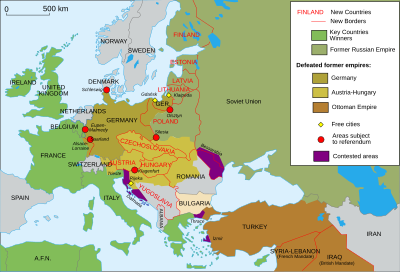
A map with the postal service-war borders in ruddy over the pre-war map of Europe. Note: this map does not prove the Irish gaelic Free State.
Countries that gained or regained territory or independence after World War I [edit]
- Armenia: independence from Russian Empire
- Australia: gained control of German New Republic of guinea, the Bismarck Archipelago and Nauru
- Austria: gained territories (Őrvidék) from Hungary
- Azerbaijan: independence from Russian Empire
- Belgium: gained control of Eupen-Malmedy and the African territories of Ruanda-Urundi from the German Empire
- Belarus People's Republic: gained command of several cities from the Russian Empire
- Czechoslovakia: gained territories from the Austrian Empire (Bohemia, Moravia, and part of Silesia) and Republic of hungary (mostly Upper Hungary and Carpathian Ruthenia)
- Danzig: semi-democratic complimentary city with independence from the German Empire
- Denmark: gained Nordschleswig afterwards a referendum from the German Empire
- Estonia: independence from the Russian Empire
- Finland: independence from the Russian Empire
- French republic: gained Alsace-Lorraine as well every bit diverse African colonies from the German Empire, and Eye East territories from the Ottoman Empire. The African and Eye Due east gains were officially League of Nations Mandates.
- Georgia: independence from the Russian Empire
- Greece: gained Western Thrace from Bulgaria
- Republic of ireland: Irish Gratis State (approximately five-sixths of the island) gained independence from the Britain (but withal office of the British Empire)
- Italy: gained South Tyrol, Trieste, Istria peninsula and Zadar from the Austro-hungarian empire
- Nihon: gained Jiaozhou Bay and most of Shandong from People's republic of china and the S Seas Mandate (both controlled by High german Empire before the state of war)
- Latvia: independence from the Russian Empire
- Republic of lithuania: independence from the Russian Empire
- New Zealand: gained control of German Samoa
- Poland: recreated and gained parts of the Austrian Empire, German Empire, Russian Empire and Hungary (small northern parts of the former Árva and Szepes counties)
- Portugal: gained control of the port of Kionga
- Romania: gained Transylvania, parts of Banat, Crișana, and Maramureș from the Kingdom of Hungary, Bukovina from the Austrian Empire, regained Dobruja from Bulgaria, and Bessarabia from the Russian Empire
- Southward Africa: gained command of Due south West Africa
- Turkey: gained command of office of the Armenian Highlands from the Russian Empire in the Treaty of Kars, while losing territory overall
- Ukraine: gained independence from the Russian Empire and recognized by Soviet Russia in the Treaty of Brest-Litovsk
- United Kingdom: gained League of Nations Mandates in Africa and the Middle East
- Kingdom of Serbs, Croats and Slovenes, created from the Kingdom of Serbia, Republic of bosnia and herzegovina, Kingdom of Croatia-Slavonia and gained parts from Austrian Empire (part of Duchy of Carniola, Kingdom of Dalmatia) and Hungary (Muraköz, Muravidék, parts of Baranya, Bácska and Banat)
Nations that lost territory or independence later World War I [edit]
- Republic of austria, as the successor country of Cisleithania in the Austro-hungarian empire
- Republic of bulgaria: lost Western Thrace to Greece likewise lost a part of Eastern Macedonia and Western Outlands to Serbia (Yugoslavia)
- China: temporarily lost Jiaozhou Bay and most of Shandong to the Empire of Japan
- Deutschland, as the successor state of the German Empire
- Hungary, every bit the successor state of Transleithania in the Austro-Hungarian Empire
- Montenegro declared union with Serbia and later became incorporated into Kingdom of Serbs, Croats and Slovenes
- Russian SFSR, as the successor state of the Russian Empire
- Turkey, as the successor state of the Ottoman Empire (although information technology did simultaneously gain some territory from the Russian Empire in the Treaty of Kars)
- United kingdom: lost most of Ireland every bit the Irish Free Country, Egypt in 1922 and Afghanistan in 1919
[edit]
The experiences of the state of war in the westward are normally assumed to have led to a sort of collective national trauma afterward for all of the participating countries. The optimism of 1900 was entirely gone and those who fought became what is known as "the Lost Generation" because they never fully recovered from their suffering. For the next few years, much of Europe mourned privately and publicly; memorials were erected in thousands of villages and towns.
So many British men of marriageable age died or were injured that the students of one girls' school were warned that but x% would marry.[31] : twenty, 245 The 1921 United Kingdom Demography institute 19,803,022 women and 18,082,220 men in England and Wales, a deviation of i.72 one thousand thousand which newspapers called the "Surplus Two Million".[31] : 22–23 In the 1921 census there were i,209 single women aged 25 to 29 for every 1,000 men. In 1931 50% were all the same single, and 35% of them did not ally while all the same able to bear children.[ citation needed ]
As early equally 1923, Stanley Baldwin recognized a new strategic reality that faced Great britain in a disarmament speech. Poisonous substance gas and the aerial bombing of civilians were new developments of the Start Earth War. The British civilian population, for many centuries, had not had any serious reason to fear invasion. So the new threat of toxicant gas dropped from enemy bombers excited a grossly exaggerated view of the civilian deaths that would occur on the outbreak of whatsoever future state of war. Baldwin expressed this in his statement that "The bomber will always go through." The traditional British policy of a balance of power in Europe no longer safeguarded the British abode population.
Ane gruesome reminder of the sacrifices of the generation was the fact that this was 1 of the first times in international conflict whereby more men died in battle than from disease, which was the main crusade of deaths in well-nigh previous wars.
This social trauma fabricated itself manifest in many unlike means. Some people were revolted by nationalism and what they believed it had caused, so they began to work toward a more internationalist earth through organizations such as the League of Nations. Pacifism became increasingly popular. Others had the opposite reaction, feeling that simply military forcefulness could be relied upon for protection in a chaotic and inhumane world that did not respect hypothetical notions of civilization. Certainly a sense of disillusionment and pessimism became pronounced. Nihilism grew in popularity. Many people believed that the war heralded the end of the globe equally they had known information technology, including the collapse of capitalism and imperialism. Communist and socialist movements effectually the earth drew forcefulness from this theory, enjoying a level of popularity they had never known before. These feelings were most pronounced in areas directly or particularly harshly affected by the state of war, such as cardinal Europe, Russian federation and France.
Artists such every bit Otto Dix, George Grosz, Ernst Barlach, and Käthe Kollwitz represented their experiences, or those of their society, in blunt paintings and sculpture. Similarly, authors such as Erich Maria Remarque wrote grim novels detailing their experiences. These works had a strong impact on society, causing a not bad deal of controversy and highlighting conflicting interpretations of the war. In Germany, nationalists including the Nazis believed that much of this work was degenerate and undermined the cohesion of order too as dishonoring the dead.

Iron harvest World War I ordnance left beside a field for disposal by the army in 2004 near Ypres in Belgium
Remains of ammunition [edit]
Throughout the areas where trenches and fighting lines were located, such every bit the Champagne region of French republic, quantities of unexploded ordnance accept remained, some of which remain dangerous, standing to crusade injuries and occasional fatalities in the 21st century. Some are establish by farmers ploughing their fields and have been called the iron harvest. Some of this armament contains toxic chemical products such as mustard gas. Cleanup of major battlefields is a continuing task with no end in sight for decades to come up. Squads remove, defuse or destroy hundreds of tons of unexploded ammunition from both World Wars every twelvemonth in Belgium, France, and Germany.[32]
Memorials [edit]

War memorials [edit]

Many towns in the participating countries accept war memorials dedicated to local residents who lost their lives. Examples include:
- Australian War Memorial, Canberra, Australia
- Liberty Memorial, Kansas City, Missouri, The states
- Memorial for The Battle of Jutland, Thyborøn, Jutland, Denmark
- Commune of Columbia State of war Memorial, Washington, DC, United States
- Beaumont-Hamel Newfoundland Memorial
- The Cenotaph, London, United Kingdom
- Menin Gate Memorial, Ypres, Kingdom of belgium
- Thiepval Memorial
- Tyne Cot Memorial to the Missing at Passchendaele
- Verdun Memorial Museum
- Vimy Ridge Memorial, Vimy, France
- Gallipoli Memorial, Turkey
- Shrine of Remembrance, Melbourne, Australia
- Irish National War Memorial Gardens, Dublin, Ireland
- Island of Ireland Peace Park, Messines, Kingdom of belgium
- National War Memorial, Ottawa, Ontario, Canada
- National War Memorial, St. John's, Newfoundland, Canada
- Kriegerdenkmal auf dem Neroberg,[33] Wiesbaden, Hessen, Germany
- Sacrario militare di Redipuglia, Fogliano Redipuglia, Italy
- Mausoleum of Mărășești, Romania
Tombs of unknown soldiers [edit]

The Amar Jawan Jyoti (the flame of the immortal warrior) in Delhi, Republic of india
- Monument to the Unknown Hero, Belgrade, Serbia
- Amar Jawan Jyoti, New Delhi, India
- Tomb of the Unknown Soldier, Ottawa, Ontario, Canada
- Arc de Triomphe, Paris, France
- The Tomb of the Unknown Warrior in Westminster Abbey, London, United Kingdom
- Tomb of the Unknowns, Arlington National Cemetery, Virginia, United States
- Tomba del milite ignoto, Rome, Italy
- Australian State of war Memorial, Canberra, Australia
- New Zealand Tomb of the Unknown Warrior, Wellington, New Zealand
- Tomb of the Unknown Soldier, Syntagma Square, Athens, Greece
- Tomb of the Unknown Soldier, Bucharest, Romania
- Tomb of the Unknown Soldier in Batalha Monastery, Batalha, Portugal
See also [edit]
- International relations (1919–1939)
- Revolutions of 1917–1923
- Interwar period
- Political history of the world
Notes [edit]
- ^ Asmuss, Burkhard (November ii, 2000). "Die Lebensmittelversorgung" [The Nutrient Supply]. Deutsches Historisches Museum (in German). Archived from the original on 2 November 2000. Retrieved 8 June 2011.
- ^ Howard, N. P. (April 1993). "The Social and Political Consequences of the Allied Food Blockade of Germany, 1918-19" (PDF). High german History. 11 (two): 161–188. doi:x.1093/gh/11.2.161 – via libcom.org.
- ^ Marks, Sally (1986). "1918 and Later: The Postwar Era". In Martel, Gordon (ed.). The Origins of the 2nd Earth War Reconsidered. Boston: Allen & Unwin. p. 19. ISBN0-04-940084-3.
- ^ Gläser (1998). The Treaty of Versailles: A Reassessment After 75 Years. New York: Cambridge University Printing. pp. 388–391. ISBN0-521-62132-1.
- ^ Germany. Gesundheits-Amt. Schaedigung der deutschen Volkskraft durch die feindliche Occludent. Denkschrift des Reichsgesundheitsamtes, Dezember 1918. (Parallel English translation) Injuries inflicted to the High german national forcefulness through the enemy blockade. Memorial of the German Lath of Public Wellness, 27 December 1918 [Berlin, Reichsdruckerei,]The report notes on folio 17 that the figures for the second one-half of 1918 were estimated based on the start half of 1918.
- ^ "The Blockade of Germany". The National Athenaeum. United Kingdom.
- ^ New-York Tribune 1919, p. 26.
- ^ ^ Connor, Steve, "Flu epidemic traced to Great State of war transit camp", The Guardian (Britain), Saturday, 8 Jan 2000. Accessed 2009-05-09. Archived 11 May 2009.
- ^ NAP [ permanent expressionless link ]
- ^ Kamps, Bernd Sebastian; Reyes-Terán, Gustavo. Influenza Book. Influenza Report. Flying Publisher. ISBN3-924774-51-X.
- ^ Handwerk, Brian (5 October 2005). "'Bird Flu' Like to Deadly 1918 Flu, Gene Report Finds". National geographic. Archived from the original on 31 October 2005.
- ^ Mark Mazower, "Minorities and the League of Nations in interwar Europe." Daedalus 126.two (1997): 47–63. in JSTOR
- ^ Table IV (page 441) of The Economic science of Aggrandizement by Costantino Bresciani-Turroni, published 1937.
- ^ Marsha L. Rozenblit (2004). Reconstructing a National Identity: The Jews of Habsburg Austria During Earth War I. Oxford UP. p. 163. ISBN9780195176308.
- ^ "ყარსის ხელშეკრულება" [Treaty of Kars]. www.amsi.ge (in Russian). 13 October 1921. Archived from the original on 27 September 2007.
- ^ "Atatürk and the Turkish Nation". State Studies. U.S. Library of Congress.
- ^ Fromkin, David (1989). A Peace to Terminate All Peace: Creating the Modern Heart East 1914–1922. New York: H. Holt. p. 565. ISBN0-8050-0857-viii.
- ^ "RP 99-020.pdf" (PDF). Archived from the original (PDF) on 2006-02-nineteen. Retrieved 2006-02-19 .
- ^ Taylor, A. J. P. (1976). English History, 1914–1945. New York: Oxford University Press. p. 123. ISBN0-19-821715-3.
- ^ Taylor, A. J. P. (1976). English History, 1914–1945. New York: Oxford University Press. p. 122. ISBN0-19-821715-three.
- ^ Barnett, Correlli (2002). The Collapse of British Power. London: Pan. pp. 424 and 426. ISBN0-330-49181-4.
- ^ Kuhlman, Erika A., Of Fiddling Comfort. 2012. pp. 120–121.
- ^ Roberts, Mary Louise (1994). Civilization without sexes : reconstructing gender in postwar France, 1917-1927. Chicago: University of Chicago Press. ISBN978-0-226-72127-9. OCLC 368265682.
- ^ Roberts, Mary Louise (1994). Civilization without sexes : reconstructing gender in postwar France, 1917-1927. Chicago: University of Chicago Press. ISBN978-0-226-72127-9. OCLC 368265682.
- ^ Roberts, Mary Louise (1994). Civilization without sexes : reconstructing gender in postwar France, 1917-1927. Chicago: University of Chicago Printing. ISBN978-0-226-72127-9. OCLC 368265682.
- ^ Roberts, Mary Louise (1994). Civilization without sexes : reconstructing gender in postwar France, 1917-1927. Chicago: University of Chicago Press. ISBN978-0-226-72127-9. OCLC 368265682.
- ^ Roberts, Mary Louise (1994). Civilization without sexes : reconstructing gender in postwar French republic, 1917-1927. Chicago: University of Chicago Press. ISBN978-0-226-72127-nine. OCLC 368265682.
- ^ Merely possibly the major hindrance to Italy's aims were the different opinions of Orlando and Sonnino: the showtime was decided to obtain Fiume and forsake Dalmatia, Sonnino did non hateful to abandon Dalmatia and would have willingly left Fiume. This indecision proved fatal for Italy, which did not gain either of the territories.
- ^ (Jackson, 1938)
- ^ Stephen G. Craft, "John Bassett Moore, Robert Lansing, and the Shandong Question." Pacific Historical Review 66.two (1997): 231–249. online
- ^ a b Nicholson, Virginia (2008). Singled Out: How Ii Million British Women Survived Without Men After the Offset Earth State of war. Oxford University Printing. ISBN978-0-nineteen-537822-1.
- ^ Neiberg, Michael (2007). The World War I Reader. p. one.
- ^ "Neroberg war memorial 1914-1918". www.werkost.com.
- New-York Tribune (November 9, 1919). "Where the fighting all the same goes on". New-York Tribune. New York, New York: New York Tribune. pp. 1–86. ISSN 1941-0646. OCLC 9405688. Retrieved Nov 10, 2019.
Further reading [edit]
- Aldcroft, Derek Howard. Europe'southward third world: the European periphery in the interwar years (2006).
- Blom, Philipp. Fracture: Life and Culture in the Westward, 1918–1938 (2015).
- Cornelissen, Christoph, and Arndt Weinrich, eds. Writing the Keen State of war - The Historiography of Globe War I from 1918 to the Nowadays (2020) free download; full coverage for major countries.
- Gerwarth, Robert. "The cardinal European counter-revolution: Paramilitary violence in Germany, Austria and Republic of hungary afterwards the great war." Past & Present 200.ane (2008): 175-209. online
- MacMillan, Margaret. Peacemakers: The Paris Peace Conference of 1919 and Its Endeavour to End War (2001)
- Kallis, Aristotle. "When fascism became mainstream: the claiming of extremism in times of crisis." Fascism 4.i (2015): 1–24.
- Mazower, Mark. Nighttime continent: Europe's twentieth century (2009).
- Mowat, C.L. ed. The New Cambridge Modernistic History, Vol. 12: The Shifting Balance of World Forces, 1898–1945 (1968) online 25 capacity; 845pp
- Overy, R. J. The Inter-War Crisis (2nd ed. 2016) excerpt
- Somervell, D.C. The Reign of King George V (1936) online 550pp; wide ranging political, social and economical coverage of Britain, 1910–35
- John Wheeler-Bennett The Wreck of Reparations, being the political background of the Lausanne Agreement, 1932 New York, H. Fertig, 1972.
External links [edit]
- Post-war, in: 1914-1918-online. International Encyclopedia of the Get-go World War.
- Kitchen, James Eastward.: Colonial Empires afterwards the State of war/Decolonization, in: 1914-1918-online. International Encyclopedia of the Get-go Earth War.
- Bessel, Richard: Post-war Societies, in: 1914-1918-online. International Encyclopedia of the Outset Earth War.
- Rothermund, Dietmar: Mail-war Economies, in: 1914-1918-online. International Encyclopedia of the First World War.
- Abrupt, Alan: The Paris Peace Conference and its Consequences, in: 1914-1918-online. International Encyclopedia of the Starting time World War.
- FirstWorldWar.com "A multimedia history of Globe War I"
- The war to terminate all wars on BBC site
- "The Heritage of the Great War"
- The British Army in the Great War
Source: https://en.wikipedia.org/wiki/Aftermath_of_World_War_I
0 Response to "after ww1 what was the most difficult thing for the us to accept quizlet"
Postar um comentário